
2026 BAH Rates Effective Jan 1, 2026 Official DoD Data
Live, searchable Basic Allowance for Housing rates for every U.S. Military Housing Area — all pay grades, with and without dependents, sourced directly from the DoD Defense Travel Management Office.
ℹ︎ BAH is identical for every branch — this filter simply narrows to common housing areas. An Army and a Navy member in the same ZIP receive the same rate.
| % covered— | |||
| No locations match your filters. |
Source: DoD DTMO · Columns show the selected dependency rate. Toggle "Show 2025 → 2026 change" to compare years.
2026 BAH rates took effect on January 1, 2026 and apply to all six branches of the U.S. armed forces. Rates are published for more than 300 Military Housing Areas, every pay grade from E-1 to O-10, in both with-dependents and without-dependents versions. The 2026 national average rose about 3.6% over 2025, with the steepest increases in high-cost coastal metros and a small number of areas seeing modest decreases.
The interactive table above is the complete 2026 Basic Allowance for Housing rate chart, drawn directly from the Department of Defense's official Defense Travel Management Office (DTMO) data. You can filter it by state and branch, search any city or installation, sort by any pay-grade column, switch between with- and without-dependents rates, compare 2025 against 2026, see how much of local rent each rate covers, and download the entire dataset as a branded CSV for your own records. If you would rather get a single answer for your exact situation, use the BAH calculator on the homepage or the Quick BAH Check box on this page.
This page focuses on the published 2026 rate chart by location and pay grade. For a plain-English explanation of what the allowance is and how each number is produced, see our pillar guide, What Is BAH?. Students using education benefits should use the dedicated GI Bill BAH calculator, which works differently.

What changed in 2026 BAH rates?
Every year, DTMO re-surveys local rental markets and republishes the entire rate table effective January 1. For 2026, the national average BAH for an E-5 with dependents climbed roughly 3.6% compared with 2025 — continuing several consecutive years of increases driven by a tight national rental market. The change was far from uniform, however:
- High-cost coastal metros saw the largest dollar gains. Areas such as Abilene/Dyess AFB, Westchester County, Northern New Jersey, San Francisco, New York City, and Boston posted some of the biggest absolute increases, reflecting persistent rent growth in supply-constrained markets. The Notable 2026 Increases panel beside the table ranks these live from the data.
- Some markets decreased. A minority of MHAs saw rates fall as local rents softened. Thanks to the DoD's individual rate-protection policy, members already stationed in those areas keep their higher prior-year rate — only members arriving after a PCS receive the lower figure.
- The member out-of-pocket share held steady. Rates remain benchmarked to cover roughly 95% of typical local housing costs for each grade, a policy in place since 2015.
To see the exact two-year movement for your own location and grade, tick “Show 2025 → 2026 change” above the table, or run your duty station through the homepage calculator, which charts 2024, 2025, and 2026 side by side.
2026 BAH rates by pay grade (E-1 to O-10)
BAH rises with pay grade. The DoD publishes a rate for 27 pay-grade bands — E-1 to E-9, warrant officers W-1 to W-5, prior-enlisted officers O-1E to O-3E, and officers O-1 to O-10. Within a single grade, your years of service do not change your BAH; only your grade, location, and dependents do.
The rate chart above shows six representative grades (E-1, E-3, E-5, E-7, O-3, O-5) so you can scan the structure quickly. A few patterns hold in every Military Housing Area:
- E-1 through E-4 usually share one rate. The Department groups the four most junior enlisted grades because their assumed housing profile is the same. You will see identical figures in the E-1 and E-3 columns for most areas.
- The rate steps up at E-5, E-6, and E-7. Senior NCOs are benchmarked to larger housing, so each promotion in this band adds meaningful, tax-free monthly income.
- Warrant and prior-enlisted officers slot in near the senior-NCO/junior-officer band. If you commissioned after four or more years enlisted, you qualify for the higher O-1E, O-2E, or O-3E rate — a detail many rate charts omit. The full calculator covers all 27 grades, including these.
- Officer rates climb steadily from O-1 to O-10. The spread between O-3 and O-5 in a high-cost area can exceed a thousand dollars a month.
To see a specific grade not shown as a column — say E-6, W-2, or O-4 — use the Quick BAH Check sidebar, which returns any of the 27 grades for any U.S. ZIP code.
How are 2026 BAH rates calculated?
DTMO sets each rate from a local rental survey. Every autumn, the Defense Travel Management Office collects tens of thousands of real rental listings in each Military Housing Area, blends median rent with average utilities and renter's insurance for six standardized housing profiles, and sets BAH to cover about 95% of that total for each pay grade. New rates publish in December and take effect January 1.
Three inputs drive every figure in the table: the Military Housing Area tied to a duty-station ZIP code, the pay grade, and dependency status. There is no percentage of salary involved — each combination maps to a fixed dollar amount. Because the calculation is anchored to local rent, two members of the same grade can receive dramatically different allowances depending on where they are stationed. That is by design: the allowance equalizes purchasing power across markets, not paychecks. For the full methodology, see how BAH is calculated.

Highest and lowest 2026 BAH rates
Because BAH tracks local rent, the gap between the most and least expensive Military Housing Areas is enormous — a senior officer in the priciest metro can receive more than four times what the same grade earns in a low-cost area.
| Military Housing Area | Monthly |
|---|---|
| Westchester County, NY | $8,064 |
| New York City, NY | $7,128 |
| San Francisco, CA | $7,089 |
| Nantucket, MA | $6,933 |
| Boston, MA | $6,483 |
| Maui County, HI | $6,378 |
Why these areas top the chart
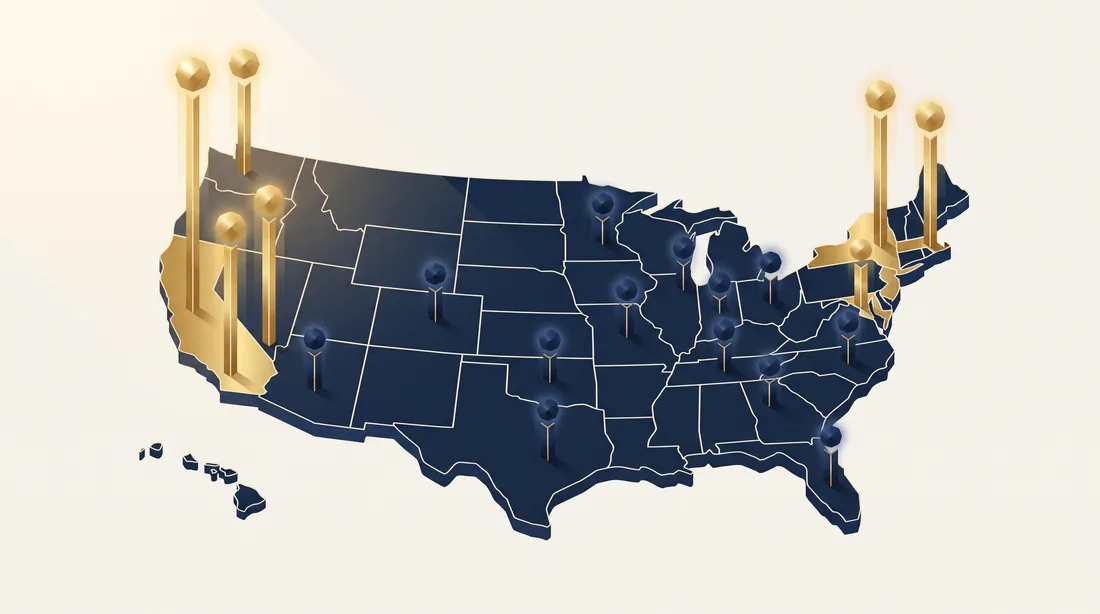
The most expensive MHAs are clustered in the Northeast corridor, coastal California, and Hawaii — markets defined by limited housing supply and relentless demand. New York City's surrounding counties (Westchester in particular), the San Francisco Bay Area, and the greater Boston region routinely produce the highest figures at every grade. For enlisted members, San Francisco and New York lead the E-5 chart at well over $5,000 a month with dependents.
At the other end, the lowest rates — bottoming out around $879 for the most junior grade in the cheapest areas — appear in smaller inland markets. The least expensive MHAs pay roughly a quarter of the top areas for an identical grade, yet each is still engineered to cover about 95% of that area's local housing cost. A lower number reflects a cheaper market, not a worse deal. Sort any column in the table above to rank all 338 areas instantly, or use the BAH by location hub to compare specific bases.
What does the “% of rent covered” column mean?
The “vs Rent” column estimates how much of local median two-bedroom rent your BAH covers. By policy, BAH is designed to cover about 95% of housing costs, but the real figure varies: in very high-cost metros, rent often outpaces the allowance (coverage in the mid-80s%), while in stable, lower-cost areas the allowance stretches further (mid-90s% and up).
This column helps you budget realistically before a move. A “covered” figure below 90% signals that you may need to spend some of your own money, choose a smaller home, or look at neighborhoods farther from base. A figure near or above 100% means a typical rental fits comfortably within your allowance, leaving room to save the difference — money that is yours to keep because BAH is a flat allowance, not a reimbursement.
The coverage estimate uses approximate local median-rent data; the BAH figures themselves are official DoD rates. For a precise affordability read on your exact home, compare your rent to your rate from the calculator, whose results card shows the same coverage meter for your grade.
How to read the 2026 BAH rate chart
Each row in the table is one Military Housing Area; each column is a pay grade. The figure where your grade meets your location is your monthly allowance. Here is how to get an accurate read:
- Find your duty-station MHA, not your home city. BAH follows the installation, so filter or search for the area that contains your base's ZIP code. If your base sits between two listed areas, the official DTMO ZIP-to-MHA assignment is definitive — the Quick BAH Check box resolves it automatically from any ZIP.
- Pick the right dependency view. Use the With / Without toggle above the table. A single qualifying dependent unlocks the higher with-dependents column; additional dependents do not raise it further.
- Use the branch filter to narrow the list. Selecting Army, Navy, Air Force, Marine Corps, Coast Guard, or Space Force focuses the table on common installations for that service. Remember the rates are identical across branches — the filter is a convenience, not a different rate table.
- Match your exact grade. The chart shows representative grades (E-1, E-3, E-5, E-7, O-3, O-5); for warrant officers, prior-enlisted officers, or any grade in between, use the Quick BAH Check or the full calculator, which covers all 27 pay-grade bands.
- Sort to compare. Click any column header to rank every location by that grade — handy for comparing potential PCS destinations or seeing which areas saw the biggest 2025→2026 change.
Prefer the data in a spreadsheet? Use the Download CSV button to export the current view (respecting your filters and dependency selection) for budgeting, a PCS comparison, or a housing-affordability analysis. The file opens with a branded header identifying the source, effective date, and the page URL.
2026 BAH rates by region
Clear patterns emerge once you group the country into regions — the Rates by Region panel beside the table ranks them live by average E-5 with-dependents BAH. Use the state filter above to drill into any of them.

Pacific (Hawaii & Alaska)
The Pacific region carries the highest regional average because island and far-north geography permanently constrains housing supply. Honolulu, Maui County, and the Alaskan hubs of Anchorage and Fairbanks all run well above the national average. Hawaii in particular sits near the top of the national chart at every grade.
Northeast corridor
The single highest individual rates in the country are here: Westchester County and New York City, Northern New Jersey, Boston, and Nantucket. Even inland New England and the Mid-Atlantic carry above-average figures. Members reporting to installations near these metros should budget carefully, as even the elevated allowance reflects genuinely steep rents.
West Coast
California dominates the high end: San Francisco, Santa Clara County, San Diego, and Los Angeles all post premium rates, and large naval and Marine Corps concentrations mean big populations draw them. Washington State's Puget Sound region (Joint Base Lewis-McChord, Naval Base Kitsap) runs high as well.
South & Gulf Coast
The South hosts enormous military populations — Fort Liberty (NC), Fort Cavazos and Fort Bliss (TX), the Hampton Roads/Norfolk Navy hub (VA), and Florida's many bases. Rates here are moderate on average, with coastal metros (Miami/Fort Lauderdale, the D.C. metro spilling into Virginia) running higher than inland posts.
Midwest & Mountain West
These regions generally carry the lowest BAH in the continental U.S., with several of the least expensive MHAs and many areas near the national floor. For members who can choose assignments, a posting here stretches the same rank's allowance much further against local cost of living.
With dependents vs. without dependents
Every cell in the chart has two values. The with-dependents rate is benchmarked to a larger housing profile and runs roughly 15% above the without-dependents rate for the same grade and location. Toggle the table between the two to see the difference for any area.
Key rules to remember when reading these columns:
- One qualifying dependent (a spouse or child) is enough for the with-dependents rate — it does not scale with the number of dependents.
- You receive the with-dependents rate even if your family does not live at your duty station.
- Members in government quarters who still support dependents elsewhere may instead receive BAH Differential, equal to the gap between the two columns.
- Dual-military couples split the rates — see how that works in our special situations section.
For the precise difference in your area, the calculator shows both rates at once.
Are 2026 BAH rates different by branch?
No. BAH rates are identical across the Army, Navy, Air Force, Marine Corps, Coast Guard, and Space Force. The DoD publishes one rate table by grade and location. An Army E-5 and a Navy E-5 in the same ZIP code receive exactly the same amount — branch affects only which installations (and therefore which housing markets) you are likely to be assigned to.
The branch filter above is a convenience that narrows the table to housing areas containing common installations for each service — Navy ports like Norfolk and San Diego, Army posts like Fort Liberty and Fort Cavazos, Air Force and Space Force bases, and Marine Corps installations like Camp Pendleton and Camp Lejeune. It does not change any rate. If you have heard people search for “Army BAH calculator” or “Navy BAH calculator,” they are all looking at this same DoD table. Explore service-specific bases on the BAH by location hub.
How to use the 2026 BAH rates
The chart is most valuable when you put it to work. Three of the most common uses:
Plan a PCS move
Before a Permanent Change of Station, look up both your current and your future Military Housing Area, then tick “Show 2025 → 2026 change” to understand the trend. A move to a higher-cost MHA raises your BAH; a move to a cheaper one can lower it, though rate protection prevents an involuntary cut while you remain continuously on active duty. Knowing the difference in advance lets you renegotiate your housing budget before you sign a lease.
Budget your housing
Compare your rate to local rents using the “% of rent covered” column. If coverage is below 90% in your area, plan to either contribute out of pocket or choose more affordable housing. Because BAH is a flat allowance, every dollar you keep below your rate is yours — a powerful, repeatable savings strategy over a career.
Weigh renting against buying
Your BAH could service a zero-down VA home loan instead of paying a landlord. Lenders may count tax-free BAH as qualifying income, which often increases buying power. In areas where your rate covers most of local rent, the monthly cost of owning can be close to renting — and each payment builds your equity instead of someone else's. The homepage results card includes a rent-vs-buy prompt for exactly this comparison.
Download the 2026 BAH rate data (CSV)
The Download CSV button exports the 2026 rate chart for every Military Housing Area in your current view, with both with- and without-dependents figures across the displayed grades, the 2025→2026 change, and the rent-coverage estimate. Each file opens with a clearly labeled header block identifying the title, the source URL (bah-calculator.org), the DoD DTMO data source, the effective date, your active filters, and a generation timestamp — so the data stays trustworthy wherever it travels.
The export is free to use for personal budgeting, PCS planning, and housing-affordability analysis. For the authoritative original source files and the complete ZIP-to-MHA mapping, visit travel.dod.mil.
2024 vs. 2025 vs. 2026 BAH rates
BAH has risen for several years running. Nationally, rates increased roughly 5% in 2024, about 5% again in 2025, and approximately 3.6% in 2026, reflecting a national rental market that climbed quickly and then began to cool in some areas. The 2026 table is the current, in-effect chart.
Multi-year context matters because it tells you whether your area is heating up or stabilizing. An MHA that posted double-digit increases two years ago and a small rise this year is likely near a plateau; an area still climbing fast may keep rising next January. The homepage calculator plots 2024, 2025, and 2026 side by side for any location and grade, and the “Show 2025 → 2026 change” toggle on this page surfaces the most recent year's movement directly in the table.
Remember that prior-year rates still matter to individuals through rate protection: if you were stationed in an area when its rate was higher, you keep that higher figure even if the published 2026 rate fell, as long as you remain continuously on active duty there. New arrivals are paid the current rate. This is why two neighbors of the same grade can draw slightly different BAH — a normal, intended outcome of the policy.
What is a Military Housing Area (MHA)?
A Military Housing Area (MHA) is the geographic unit that sets your BAH. The continental U.S., Hawaii, and Alaska are divided into roughly 300+ MHAs — each a cluster of ZIP codes built around one or more installations and the rental market that surrounds them. Your duty-station ZIP code maps to exactly one MHA, and that MHA's rate table determines your allowance.
Each row in the chart above is one MHA. Many large installations share an MHA with their host city — for example, Naval Station San Diego, MCAS Miramar, and Marine Corps Recruit Depot San Diego all fall within the “San Diego, CA” MHA, so members at any of them who live off post draw the same location rates. That is why you may not find your specific base by name: search the metro area instead, or let the Quick BAH Check convert your ZIP to the correct MHA automatically.
MHA boundaries are defined by DTMO and updated periodically. A handful of ZIP codes sit on the boundary between two areas; in those cases the official DTMO assignment is definitive. Overseas duty stations are not part of the BAH/MHA system at all — members stationed abroad receive the Overseas Housing Allowance (OHA) instead, which is calculated on actual local rent rather than an MHA rate.

2026 BAH rates for major military bases
Some of the most-searched Military Housing Areas, with the E-5 with-dependents figure as a reference point. Each links to a dedicated page with the full pay-grade chart and local housing context:
- San Diego, CA — Navy and Marine Corps hub (Naval Station San Diego, MCAS Miramar, Camp Pendleton nearby). High-cost coastal market.
- Norfolk, VA — the world's largest naval base and the Hampton Roads region. Moderate-to-high rates.
- Honolulu County (Oahu), HI — Joint Base Pearl Harbor-Hickam, Schofield Barracks, MCB Hawaii. Among the highest in the nation.
- Fort Liberty, NC (formerly Fort Bragg) — the Army's largest installation by population, in the Fayetteville market.
- Joint Base Lewis-McChord, WA — Army and Air Force, in the high-cost Puget Sound region near Tacoma.
- Fort Cavazos, TX (formerly Fort Hood) — a large Army post in the affordable Killeen–Temple market.
- San Antonio, TX — Joint Base San Antonio (Fort Sam Houston, Lackland, Randolph). Lower-cost, multi-service.
For any base not listed, search the table above or browse the complete BAH by location hub. Every U.S. ZIP code is covered by the calculator.
Common mistakes when reading BAH rates
A few errors trip people up every year. Avoid them and your budget will be accurate:
- Using your home ZIP instead of your duty-station ZIP. BAH follows the installation, not your lease. The rate for where you work, not where you sleep, is the one that counts.
- Reading the wrong dependency column. Confirm the With/Without toggle matches your status. The gap is roughly 15% — a meaningful sum to mis-budget.
- Assuming more dependents means more BAH. One qualifying dependent unlocks the with-dependents rate; additional dependents do not increase it.
- Forgetting prior-enlisted officer rates. O-1E, O-2E, and O-3E pay more than the standard O-1/O-2/O-3 and are not shown as table columns — check them in the Quick BAH Check.
- Expecting your rate to drop automatically when the published number falls. Rate protection keeps your figure from being cut while you remain at the same station on continuous active duty.
- Treating the rate as guaranteed after service. BAH stops at separation or retirement; plan any home purchase with that in mind.
For a deeper list, see the common BAH mistakes on the homepage.
BAH is tax-free — so these rates are worth more than they look
BAH is excluded from federal income tax under 26 U.S.C. § 134. A rate of $3,000/month in the chart is worth the equivalent of a larger taxable salary — often 20–40% more in pre-tax terms — because you keep all of it. When comparing the figures here to a civilian housing budget or job offer, “gross up” the rate to its pre-tax equivalent.
This tax advantage is also why mortgage lenders may count BAH as effective (even grossed-up) income on a VA loan application — turning the rate in this table into real buying power. It is one of the most valuable and overlooked features of military pay. For the full picture of how BAH fits alongside base pay and BAS, see how BAH fits into your total compensation.
Glossary: terms in this rate chart
| Term | What it means |
|---|---|
| MHA | Military Housing Area — the ZIP-code cluster that sets your local rate (each table row). |
| DTMO | Defense Travel Management Office — the DoD office that surveys rents and publishes BAH rates. |
| With / without dependents | The two rate tiers; one qualifying dependent unlocks the higher tier. |
| 2025 → 2026 change | The dollar difference in the E-5 with-dependents rate versus last year, shown when toggled on. |
| % of rent covered | Estimated share of local median 2-bedroom rent the rate covers; lower in high-cost metros. |
| Rate protection | Policy preventing your BAH from dropping while you remain at the same station on active duty. |
| OHA | Overseas Housing Allowance — replaces BAH for members stationed outside the U.S. |
| CONUS | Continental United States — the area (plus HI and AK) where BAH, not OHA, applies. |
2026 BAH rates: frequently asked questions
When did 2026 BAH rates take effect?
2026 BAH rates took effect on January 1, 2026, and remain in place through December 31. New rates are published every December based on DTMO's autumn rental-market survey.
How much did BAH go up in 2026?
The national average rose about 3.6% over 2025 for an E-5 with dependents. Individual areas varied widely — some high-cost metros rose far more, while a minority of markets decreased. Use the “Show 2025 → 2026 change” toggle to see your area.
Are 2026 BAH rates the same for every branch?
Yes. The DoD publishes one rate table used by the Army, Navy, Air Force, Marine Corps, Coast Guard, and Space Force. Two members of the same grade and ZIP code receive identical BAH regardless of branch.
What is the highest 2026 BAH rate?
For an O-5 with dependents, Westchester County, NY tops the chart at about $8,064/month, followed by New York City and San Francisco. The lowest rates fall near $879 for the most junior grade in the least expensive areas.
Can I download the full 2026 BAH chart?
Yes — use the Download CSV button above to export every location in your current view, including the 2025→2026 change and rent-coverage estimate. The complete official source files are also available from DTMO at travel.dod.mil.
Why is my base not listed separately?
BAH is set by Military Housing Area, and many installations share one MHA with the surrounding city. Search the metro your base belongs to, or use the Quick BAH Check, which converts your ZIP code to the correct MHA automatically.
Do BAH rates ever go down?
Published rates can fall in areas where local rents soften, but individual rate protection means members already stationed there keep their higher rate while continuously on active duty. Only members who newly arrive after a PCS receive the lower current rate.
What grades does the table show?
The chart displays six representative grades (E-1, E-3, E-5, E-7, O-3, O-5). For any of the other 21 grades — including warrant officers and prior-enlisted O-1E to O-3E — use the Quick BAH Check sidebar or the full homepage calculator.
How accurate are the rates on this page?
The BAH figures are official DoD DTMO rates, processed directly from the Department's published 2026 data. The “% of rent covered” column uses an approximate median-rent estimate for context. For your exact, official entitlement, always confirm with DFAS or your finance office.
Is there a 2026 BAH rate for my specific rank like E-6 or O-4?
Yes — every grade has a rate. The table shows six common grades as columns; for E-6, O-4, warrant officers, or any other grade, enter your ZIP in the Quick BAH Check or use the homepage calculator, which covers all 27 pay-grade bands.
Do Reserve and Guard members get these rates?
On active-duty orders longer than 30 days, yes — the same full rates apply, based on the duty-station MHA. On shorter orders, members receive BAH RC/T, a flat rate based on their home ZIP code instead.
What's the difference between these rates and GI Bill housing allowance?
These are active-duty BAH rates. The Post-9/11 GI Bill pays the E-5 with-dependents rate for your school's location regardless of your rank, with a flat national rate for fully online study. Use the dedicated GI Bill BAH calculator for school.
A worked example: budgeting from the 2026 chart
Numbers are easier to trust when you see them used. Suppose you are an E-5 with one child receiving orders to San Diego, CA. From the chart, the 2026 E-5 with-dependents rate is about $3,975/month, and the “% of rent covered” column shows roughly 88% — meaning a typical local two-bedroom rents for a bit more than your allowance. Your plan writes itself: either budget around $500/month out of pocket for a typical place, or target a more affordable neighborhood (Chula Vista, El Cajon, Oceanside) where rent sits at or below $3,975 so you keep the full allowance.
Now compare that to the same rank in San Antonio, TX, where the E-5 with-dependents rate is about $1,869/month but coverage runs near 96% because rents are far lower. The dollar figure is less than half of San Diego's, yet your housing stress is actually lower — the allowance covers more of the local market. This is the whole point of a location-based allowance: it equalizes purchasing power, not paychecks. Reading both the rate and the coverage column together gives you the real picture, which a raw dollar amount alone cannot.
Run your own numbers in seconds with the homepage calculator — it returns the monthly, annual, and daily figure plus the affordability meter for any ZIP and grade.
How to compare two duty stations side by side
One of the most useful things you can do before a PCS is compare your current and future Military Housing Areas directly. With the chart above, the workflow is simple:
- Search your current MHA and note your grade's figure with the correct dependency toggle.
- Clear the search and look up your future MHA. Note the same grade's figure and its “% of rent covered.”
- Sort the table by your grade's column to see where each area ranks nationally — a quick gut-check on whether you are moving up or down the cost ladder.
- Tick “Show 2025 → 2026 change” to see whether the destination is trending up or down.
- Download the CSV if you want both rows saved for a side-by-side spreadsheet, or to share the comparison with a spouse or realtor.
The difference between two MHAs can be thousands of dollars a year for the same rank — money that should shape which neighborhoods you tour and whether you rent or buy. Because rate protection prevents an involuntary decrease while you stay on active duty, there is rarely downside to confirming the higher-cost area's number early. For base-specific context — installations, neighborhoods, and the full pay-grade chart — open the matching page from the BAH by location hub.
Do these 2026 rates apply to the Reserve and National Guard?
Yes — when activated on longer orders. Reserve and National Guard members on active-duty orders of more than 30 days draw the same full BAH rates shown in this chart, calculated on their duty-station Military Housing Area. For shorter activations (30 days or fewer), they instead receive BAH RC/T (Reserve Component/Transient), a separate flat rate based on their permanent home ZIP code.
This distinction matters for budgeting around a mobilization. A Guardsman activated for a year-long deployment to a high-cost MHA receives that area's full Type I rate from this table; the same member on a two-week annual training tour receives the much smaller RC/T figure instead. If you are weighing a set of orders, knowing which rate applies can mean a significant difference in housing pay. For the full breakdown of reserve-component allowances, see our guide to BAH Type II and RC/T.
These rates are for active duty — students use a different figure
If you are using the Post-9/11 GI Bill rather than serving on active duty, do not read your housing allowance from this table. The GI Bill pays a Monthly Housing Allowance based on the E-5 with-dependents rate for your school's ZIP code, regardless of your actual former rank — and fully online programs receive a flat national rate instead. Use the dedicated GI Bill BAH calculator to get the right number for school. Active-duty members and those planning a PCS should keep using the chart above.
What to expect for 2027 BAH rates
While 2026 rates are fixed through December 31, it helps to understand the cycle. DTMO surveys rents in the autumn and publishes the following year's table in December, effective the next January 1. If the national rental market continues to stabilize, 2027 increases may be smaller than the double-digit jumps seen in 2023; if rents reaccelerate in your region, expect a larger bump. Either way, rate protection guarantees your current rate will not be cut while you remain at the same station on continuous active duty.
We update this page and the underlying data as soon as DTMO releases the new figures each December, so bookmark it and check back in the new year. In the meantime, the “Show 2025 → 2026 change” toggle and the homepage calculator's three-year history are the best tools for reading the direction of your own Military Housing Area.
Data sources, methodology & accuracy
Every rate in this table originates from the official annual rate files published by the Department of Defense's Defense Travel Management Office (DTMO) — the same authority your finance office uses. We process the published ASCII rate tables and the ZIP-to-MHA mapping for 2024, 2025, and 2026, and refresh them when DTMO releases new data each December. The rent-coverage column layers in an approximate median-rent estimate for context; the BAH figures themselves are official.
This is an independent educational resource, not a government system of record. Individual entitlements can depend on details — exact dependency documentation, special duty circumstances, mid-year adjustments — that only your finance office and DFAS can confirm. We cite primary sources (U.S. Code, DTMO, DFAS) throughout and date our updates. Content is reviewed by Daniel Reyes, Military Pay & Benefits Specialist. Last reviewed June 30, 2026.